Portugal grows above European average, reduces debt, and maintains balanced public finances
Draft State Budget combines sound public finances with support for households and businesses
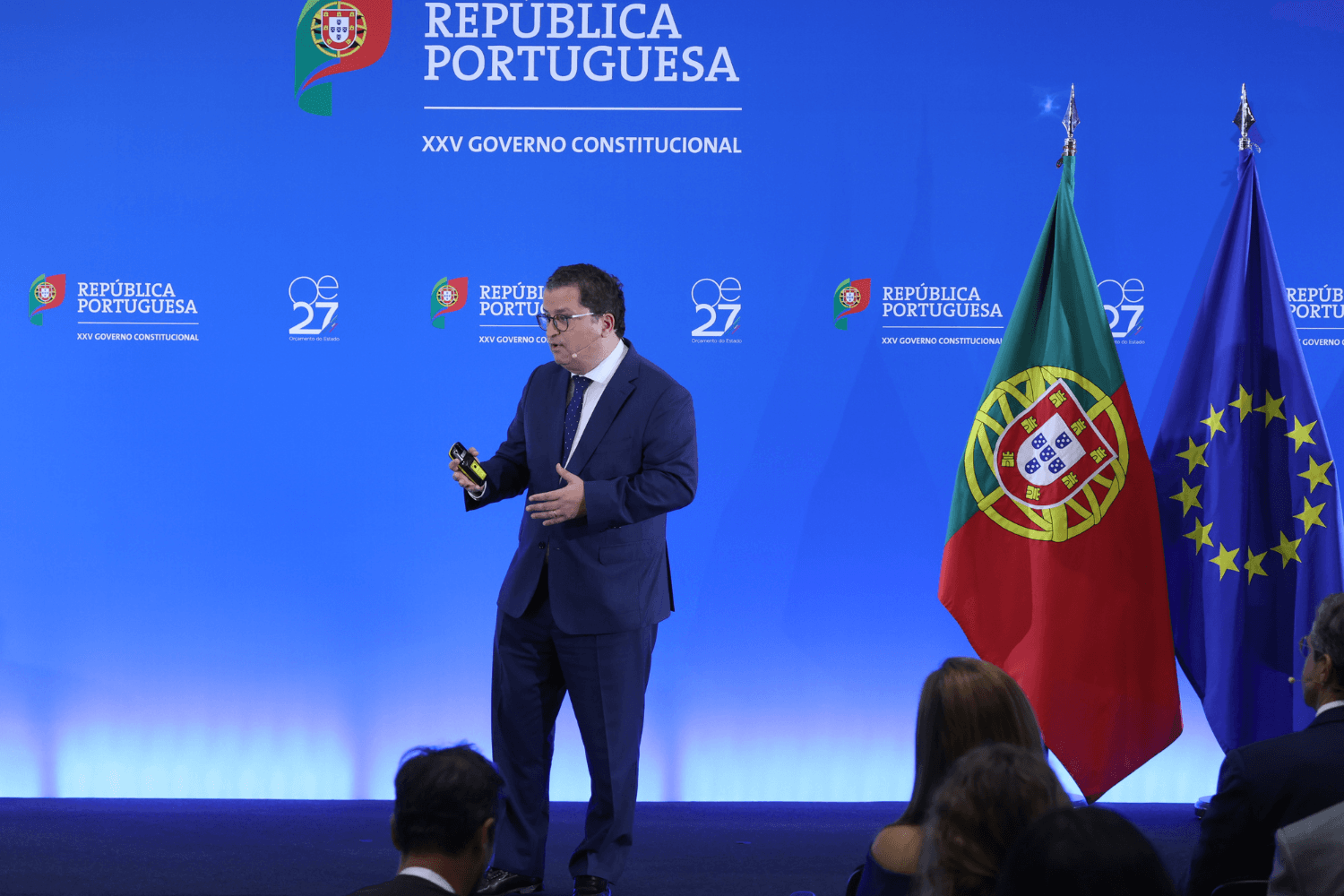
The Minister of State and Finance, Joaquim Miranda Sarmento, during the presentation of the draft State Budget for 2027

Portugal enters 2027 better prepared for the future, both economically and in terms of public finances. The country is expected to stand out for its sound public finances, another year of economic growth above the European average, and continued public debt reduction.
The Portuguese economy is expected to grow by more than 2%, above the 1% forecast by the OECD for the Euro Area. This follows a year in which GDP increased by more than 2%, despite international geopolitical challenges, including the conflict in Iran, and domestic difficulties, particularly the succession of storms that struck the country in the first quarter of 2026.
The strength of the Portuguese economy is also reflected in the unemployment rate, which is expected to remain at historically low levels, falling from 5.8% to 5.7%. Inflation is projected to stand at 2.3%.
At the same time, the Government remains committed to reducing public debt, making the country increasingly resilient to potential external shocks while improving Portugal’s access to financing on international markets.
The 2027 State Budget therefore forecasts a three-percentage-point reduction in the public debt-to-GDP ratio, bringing it down to 84.5%. In 2025, this indicator fell below 90% for the first time in 16 years.
The Minister of State and Finance, Joaquim Miranda Sarmento, stressed that this reduction “is the result of the efforts made by households and businesses in recent years”. He recalled that, despite this achievement, the path of fiscal consolidation “cannot be interrupted, and it is necessary to maintain a small budget surplus and a sustained pace of public debt reduction”.
In budgetary terms, 2027 is expected to record the fifth consecutive budget surplus since the restoration of democracy, with a projected surplus of 0.1% of GDP.
For 2026, the Government estimates a balanced budget or a small surplus, despite the support measures introduced in response to Storm Kristin and the conflict in Iran, an extraordinary reduction in personal income tax (IRS) — the fifth such reduction — and a new extraordinary supplement for pensioners.
Thanks to the positive results achieved over the past three years, Portugal is now better prepared to face new challenges, demonstrating that it is possible to support current generations while maintaining balanced public finances without compromising the future.