Portuguese economy continues to grow at a solid pace
Minister of Economy and Territorial Cohesion Castro Almeida at the debate in Parliament, 22 May 2026 (Tiago Petinga/Lusa)
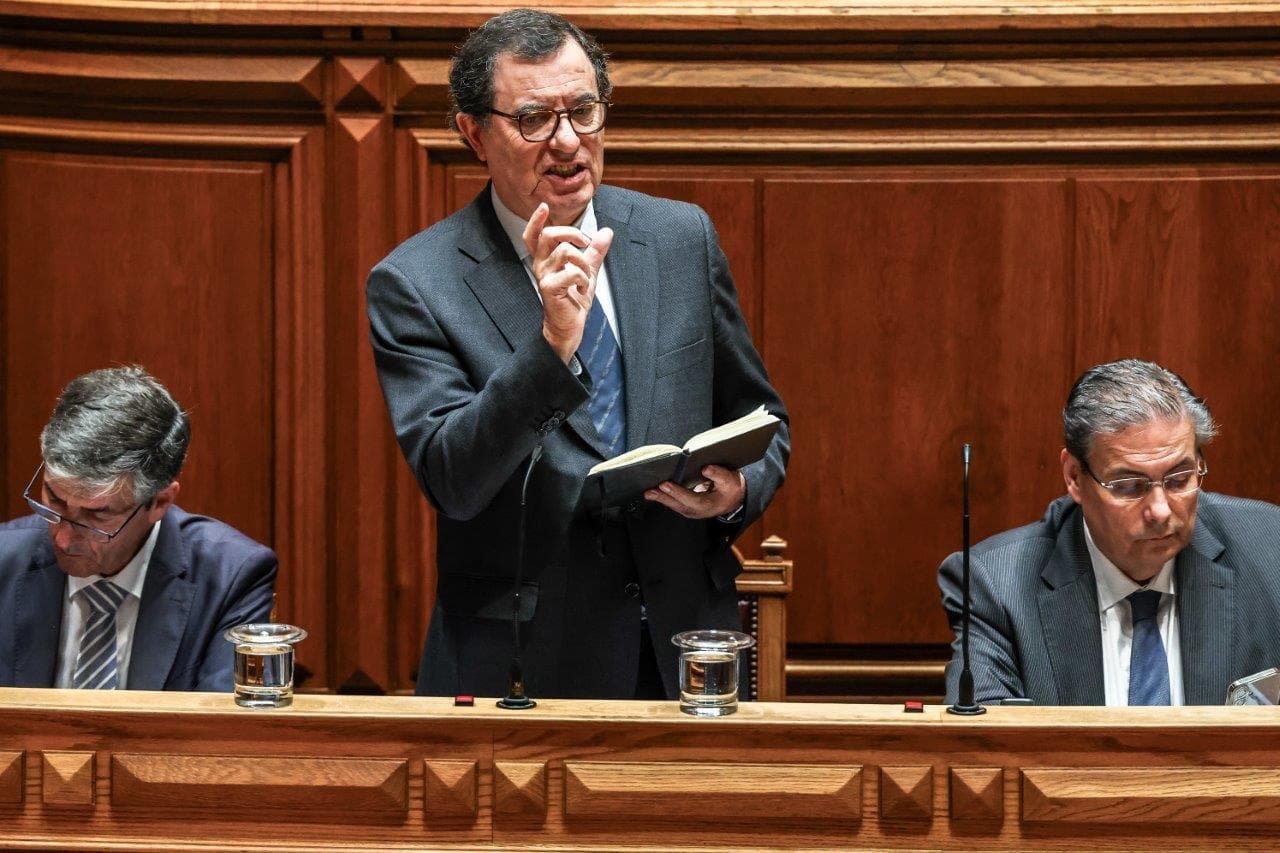
Minister of Economy and Territorial Cohesion Castro Almeida at the debate in Parliament, 22 May 2026 (Tiago Petinga/Lusa)
Minister of Economy and Territorial Cohesion Castro Almeida at the debate in Parliament, 22 May 2026 (Tiago Petinga/Lusa)

“The Portuguese economy continues to grow at a solid pace. In the first quarter of 2026, GDP grew 2.3% like for like, speeding up when compared to the previous year” and “despite the impact of the storms and the conflict in the Middle East”, claimed the Minister of Economy and Territorial Cohesion Castro Almeida in Parliament.
Income “has also gone up with (minimum and average) wages rising above inflation”. There are 85 foreign investment projects under analysis representing “over 22 billion euros”, he added.
Exports, after having slowed down in the first months of the year, had a very significant recovery in March, the best month ever, up 20.9% on the previous month.
Castro Almeida stressed that “these are not just numbers. They are companies that invest. They are jobs that are created. They are income that is generated. They are real opportunities for the Portuguese”.
Consistent policies
The Minister said that the Government is applying consistent policies that create conditions for investment and employment, noting the following: The Reforçar programme, which has allocated 5.3 billion euros of the 10 billion euros approved a year ago to support competitiveness, exports, and internationalisation, and the Financial Instrument for Innovation and Competitiveness (IFIC), with over 4.5 billion euros in investment in re-industrialisation.
The Government is also “facing a structural problem in our economy – bureaucracy – and is “preparing a profound reform of the licensing scheme, setting up a joint model” for industry, tourism, trade, services, and restaurants.
The aim is to “cut timeframes, eliminate uncertainty and lower costs for those who wish to invest and create wealth”, extinguishing “that hidden task which is the time we make companies waste”.
PTRR
Castro Almeida also mentioned the PTRR, the 22-billion-euro plan to transform the country, which is “not limited to reacting to” the storms this winter, “it sets the conditions for the country to come out stronger, better prepared, and more competitive”.
The Minister indicated in this plan “two decisive dimensions for the country’s future: energy and the development of business parks”.
“In an unstable world, energy is no longer a sectoral issue; today, it is a matter of sovereignty and economic competitiveness” and the PTRR responds to this challenge by boosting energy autonomy, reducing external dependence and ensuring continuity of critical systems because “there is no strong economy without a robust, resistant, and autonomous energy system”.
The PTRR also sets the conditions for a new generation of business and technology parks spread throughout the territory, particularly in the inland areas”, with “infrastructure, services, and licenses assured early on, making Portugal more attractive for investment”.
“This will be a structural shift: less red tape, more predictability, more capacity to attract large-scale industrial and technological projects, and more opportunities for the inland areas”, he said.
Storms
Castro Almeida also made note of the recovery of the damages caused by the storms, assessed at five billion euros, recalling that “the State responded swiftly with concrete measures”.
The Minister praised the joint work by the municipalities and the Regional Coordination and Development Commissions (CCDR), noting that “there is still much to be done in granting assistance up to €10,000, although 13 municipalities have completed all the processes and 10 are above 90%”.