Two years working for Portugal’s future
Prime Minister celebrates two years in Government noting reforms and economic and social outcomes
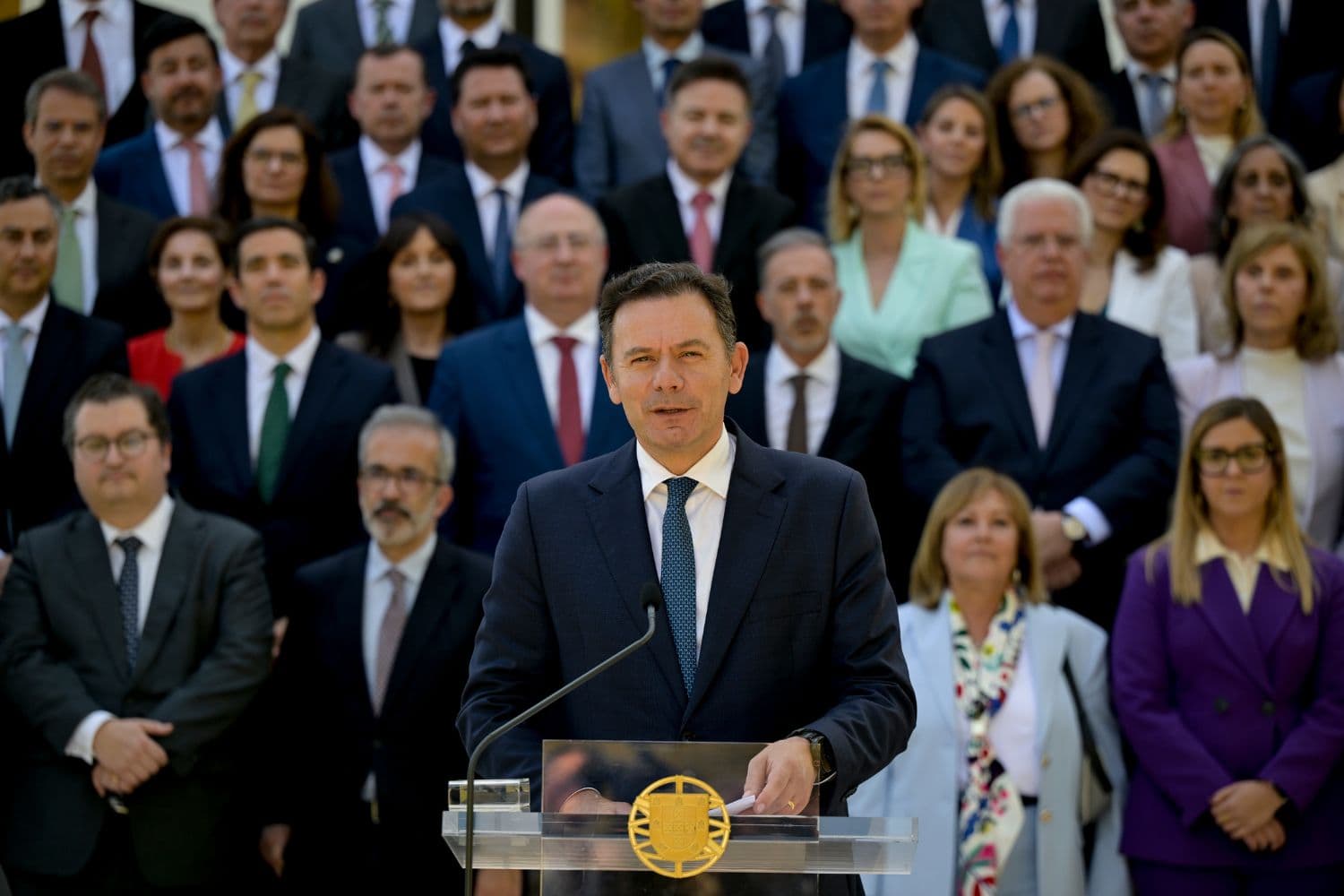
Prime Minister Luís Montenegro celebrates two years in office, Official Residence, Lisbon, 2 April 2026 (Gonçalo Borges Dias / GPM)
Prime Minister Luís Montenegro celebrates two years in office, Official Residence, Lisbon, 2 April 2026 (Gonçalo Borges Dias / GPM)

Two years after taking office as the Prime Minister, Luís Montenegro noted the economic outcomes achieved, the strengthening of the Social State and the different reforms under way to conclude that "the country is doing better, as are the Portuguese people". On the same occasion, the Prime Minister announced a new instrument to support the companies that face the rising energy costs in the amount of 600 million euros.
The speech, given at the Official Residence in Lisbon, was attended by several members of both the Prime Minister’s Governments and was a moment to take stock, positively, of the governing action, as well as to project the next reforms, recalling the commitment undertaken two years ago: "to solve people’s problems and transform Portugal with ambition and a winning mindset ".
More income, youths, and social support
In the economic and social field, the strategy to boost disposable income represented four income tax cuts, freeing up more than two billion euros for households.
Policies aimed at youth were also boosted with the Youth Income Tax, a rise in net income and measures for accessing housing, including public guarantee and tax exemptions when buying a home.
On a social level, the Government boosted the solidary benefit for the elderly, ensured 10% co-payment of medicines for the most vulnerable, granted two additional benefits and updated pensions annually.
Government launches "Portugal Energy Resilience" facility in the amount of 600 million euros
The Prime Minister stressed investment in the corporate fabric as a driver for wealth with the decision of gradually cutting corporate income tax by 17% in 2028, encouraging investment, innovation, and job creation.
Under this framework, the new "Portugal Energy Resilience" facility was announced in the amount of 600 million euros, developed by the Portuguese Development Bank for companies facing the rising energy costs arising from the conflict in the Middle East.
Balanced accounts and economic performance
Portugal recorded two budget surpluses in a row and a public debt reduction to levels below 90% of GDP for the first time in 16 years.
Luís Montenegro also noted full employment, a historically low unemployment rate and rising wages, with results that surpassed the economic forecasts and contradicting pessimist scenarios.
Social state, public services and quality of life
The State’s valorisation included 39 agreements with trade unions and revising 29 careers, covering more than 350 thousand workers.
The measures covered several sectors, including teachers, law enforcement and security forces, healthcare professionals, justice officials and prison guards, strengthening attractiveness of public careers.
In healthcare, the Government moved forward with an emergency and transformation plan, followed by structural reforms, namely in the INEM (EMS) and reorganising obstetrician, gynaecology, and paediatric services.
The National Health Service remains the foundation of the system, articulated with the social and private sectors, focusing on increasing response capabilities and recovering access to healthcare.
In housing, the largest investment ever was made in public housing, together with incentives on building and making homes available at moderate prices.
The Government also simplified the rules, cutting timeframes and procedures to expedite housing projects.
Infrastructures, reforms, and a vision of the future
In mobility, structural decisions were made, including the location of the new Luís de Camões airport after decades of undefinition.
We also note the largest investment ever in rails with the start of high-speed trains and the creation of the monthly train pass at 20 euros per month, which enables travelling throughout almost the entire network and should reach one million users.
In immigration, the Prime Minister stressed a policy of "resolution and humanism", ensuring decent hosting for those who work and return to the country of origin for those who do not follow the rules.
The Government is moving forward with structural reforms, including countering red tape and corruption, the reform of public procurement, and changes to how the Court of Auditors functions.
The negotiation of the labour law is also under way and the preparation of a new social action law for higher education with a focus on equal opportunities and valuing merit.
The Prime Minister stressed the capacity to respond to extreme weather events and announced the development of the Portugal Transformation, Recovery and Resilience Plan (PTRR), complementing the execution of the RRF and Portugal 2030.
Continuing to transform
Luís Montenegro remarked that the results were achieved in a particularly demanding international context and reaffirmed the commitment to continuing reforms, stressing that "we are here with the same focus, willingness and courage with which we started this path two years ago, to act, transform, strive, fight, and achieve the results we set out", ensuring that the Portuguese can count on "stability and the sense of responsibility to transform Portugal".